
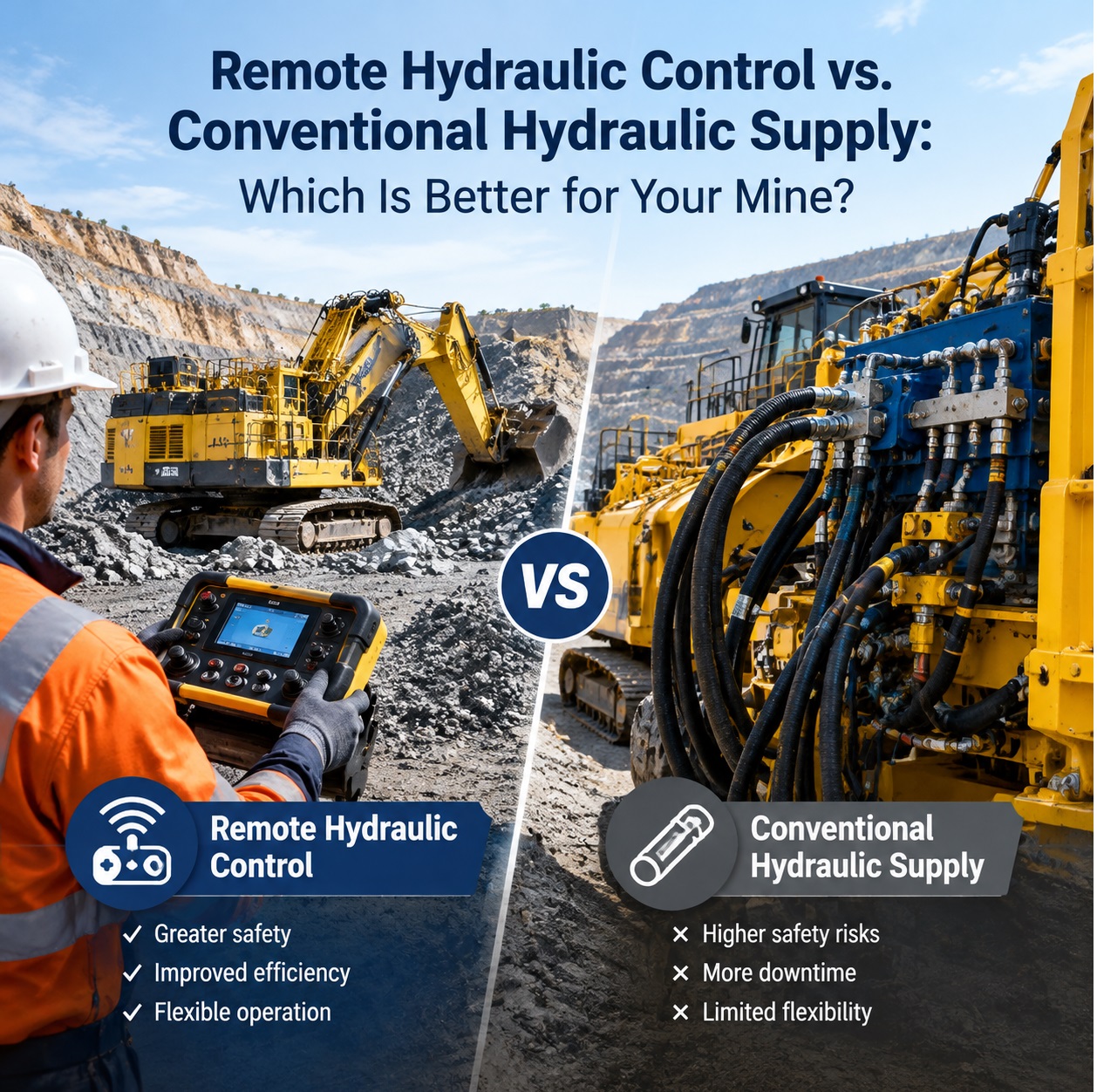
 If your operator is still standing three meters from a loaded bucket with one hand on a manual valve, you are not running a mine. You are running a lottery with a very long ticket.
I have walked through enough pits and plants to know how this argument usually starts. Somebody in procurement opens a spreadsheet. Conventional hydraulic supply looks cheap on paper. Remote hydraulic control looks expensive. The spreadsheet wins, the purchase order gets signed, and eighteen months later the maintenance superintendent is the one explaining why the hose bill alone would have covered the retrofit.
So let us actually have the conversation.
What conventional really means out in the field
Conventional hydraulic supply is the architecture most mines inherited. A central pump station or a dedicated power pack, long runs of hose and tubing snaking out to each actuator, and manual directional valves sitting somewhere within arm’s reach of the machine. Somebody has to be there to move that lever. That somebody is usually standing in a spot you would not let your own kid stand in.
It works. I will give it that. It is simple, it is repairable with a pipe wrench and some swearing, and every fitter on site has been working on it since his apprenticeship. That familiarity is worth real money.
The physics, though, does not care about familiarity. Every meter of hose between the pump and the actuator is pressure drop, heat, and a leak waiting for a rock to fall on it. Long runs mean more fluid volume, slower response, and a system that behaves like it is thinking about the job before it moves. When you have a bucket full of ore and a highwall behind you, thinking about it is not a feature.
What remote hydraulic control actually changes
Remote hydraulic control does not mean you remove the hydraulics. That misunderstanding has killed more good projects than bad engineering ever did. It means you stop moving fluid to the operator and start moving a signal instead.
The valve manifold goes where the work is. Pilot lines, or better, electro-hydraulic actuators, sit right beside the cylinder they control. The operator sits in a cab, a control room, or a safe standoff position with a joystick or a radio. Short hydraulic runs. Low pilot pressure. Fast response. Hands nowhere near the pinch points.
Three things change the moment you make that switch.
Safety. The person making the decision is no longer inside the hazard zone. On a rockbreaker, a boom, a chute gate, or an underground mucking cycle, that single change removes the most common serious-injury scenario on the entire site.
Cycle time. Short runs and pilot-operated valves respond faster. On a high-cycle application that difference compounds across a shift. I have watched operations pick up double-digit percentage gains in throughput without touching the size of the machine.
Diagnostics. This is the part nobody markets hard enough. A modern remote system will tell you pilot pressure, coil current, valve position, and fault codes before the machine stops working. A conventional system tells you something is wrong when a hose bursts and the floor gets slippery.
Now put a number on it. Hose and fitting replacement on a long-run conventional setup is a recurring line item that most sites badly underestimate. Add fluid loss, cleanup, labor hours, and the production you gave up while a fitter crawled under a chassis with a torch. Then add the insurance conversation you have after the third near-miss of the year. The cheap system stops looking cheap somewhere around month fourteen.
Where conventional still earns its keep
I am not going to pretend remote control wins everywhere. It does not.
A single, fixed, low-cycle application with an operator station that is already safe and close? Conventional is fine. A small aggregate gate. A yard press. A legacy machine grandfathered into a regulatory exemption. Spending six figures to remote-control something that runs twice a day is not engineering, it is decoration.
There is also the skills question. Electro-hydraulic systems need people who understand both sides of the fence, and in plenty of regions that person is harder to find than the system is to buy. If your maintenance crew cannot read a wiring diagram, a remote system will sit in bypass mode within a month and everyone will blame the technology.
The honest decision framework
Four questions before you spend anything.
How close does the operator have to stand to the load? If the answer involves the words line of fire, stop reading and start quoting.
How many cycles per shift? Under a few hundred, conventional is defensible. Over a thousand, remote control pays for itself on cycle time alone, before you count the injuries you did not have.
How long is the supply run? Past roughly fifteen to twenty meters, you are burning energy and response time for no good reason.
Can you support it? If you cannot staff the maintenance, buy the training with the system. Otherwise you have purchased a very expensive conversation piece.
The retrofit question
Most mines are not choosing between two new machines. They are choosing whether to retrofit what they already own, and that changes the math in a good way. A well-designed remote package can be bolted onto an existing machine, keeping the original cylinders and often the original power unit, and replacing only the control layer. You keep the iron you already paid for and fix the part that was actually dangerous and slow.
Stage it if you have to. Start with the machine that has the worst safety record and the highest cycle count. Prove the numbers. Let the shift reports argue for the next one. Nothing sells a remote system to a skeptical maintenance crew faster than the results from the machine next door.
The bottom line, if you want one
Conventional hydraulic supply is not wrong. It is just old, and old is not the same as adequate. The real question was never fluid versus signal in the abstract. The question is whether the person controlling your machine needs to be standing next to it, and in almost every modern mining application, the answer is no.
Stop sizing hoses. Start sizing distance. And if you are not certain which side of that line your operation sits on, get someone who has stood in both places to walk your site with you before you sign anything. The site assessment is free. The injury is not.

