
My take? If you pressure-wash an asphalt shingle roof, you’re usually playing with fire.
Not literal fire, obviously. I mean you’re gambling with granules, flashing, and the one thing roofs hate most: water being forced where it doesn’t belong.
That said, “never pressure wash” isn’t universally true. A few roof types can handle carefully managed pressure. The trick is knowing what you’ve got overhead, and what you’re willing to risk.
Start with what you’re actually trying to fix (not what looks ugly)
Roof stains aren’t all the same problem wearing different clothes.
Those black streaks? Usually algae (often Gloeocapsa magma). Green fuzz? Moss. Sandy runoff in your gutters? That’s shingle granule loss, cleaning won’t repair that, and aggressive washing can make it worse.
Here’s the thing: most roof “dirt” is biological, not mud. And biology doesn’t require blasting. It requires killing and rinsing. That’s why understanding pressure washing vs soft washing roofs matters before you decide how to clean yours.
Pressure washing: fast, satisfying, and rough on roofs
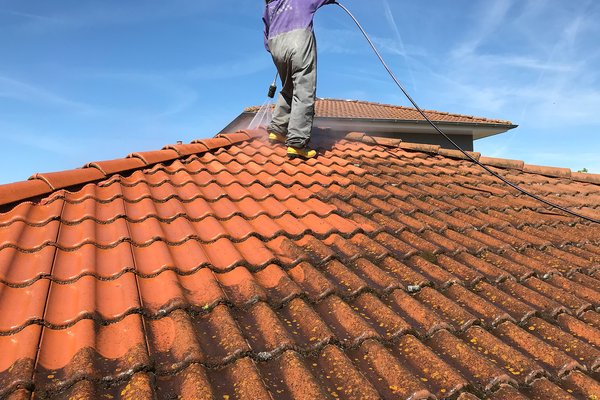
Pressure washing cleans by force. That’s both the appeal and the danger.
On a roof, that force can do a few specific kinds of harm:
Shingles: granules aren’t decoration
Asphalt shingles rely on granules for UV protection and durability. Strip them and the shingle ages faster, sometimes a lot faster.
I’ve watched people hold a wand a little too close “just to get that last stain,” and suddenly the surface looks cleaner… because they’ve scoured it. You can’t put those granules back.
Common pressure-wash mistakes I see:
– Spraying up the roof slope (water gets driven under tabs)
– Using a tight nozzle (0° or 15°) on shingles
– Cleaning an older roof like it’s a concrete driveway
– Hanging out near ridge caps and edges where lifting is easiest
Flashing and seals: the sneaky failure point
High pressure doesn’t need to bend flashing dramatically to cause damage. It can degrade sealant beads, open small gaps, or drive water behind metal where it sits quietly and rots things out.
And the worst part? You might not notice for months.
Vents and ventilation: grit goes places you don’t want it
When you blast a roof, debris doesn’t just “go away.” It goes somewhere. Granules and grit can get shoved into vent screens, soffit areas, even valleys and transitions where it clogs drainage paths. That’s how you end up trapping moisture, exactly what algae and moss love.
One-line truth:
Pressure washing can create the next problem while “solving” the current one.
Soft washing: less drama, more chemistry (and usually the safer bet)
Soft washing is basically controlled chemical cleaning plus gentle rinse. Instead of relying on mechanical abrasion, you’re breaking the bond between the organism and the roof surface.
That matters because shingles are not designed to be sandblasted.
A proper soft wash approach:
– Applies a roof-safe mix at low pressure
– Lets it dwell long enough to kill algae/moss
– Rinses with low pressure so you’re not driving water under the system
– Minimizes granule loss and lifting risk
Now, this won’t apply to everyone, but… if your goal is to preserve the roof, soft washing is usually the move. Most of the time I’d rather see a faint leftover stain for a week than a “perfect” roof that’s been prematurely worn down.
“But chemicals!” Yeah. Let’s talk about that.
Soft washing isn’t automatically gentle on everything. Overspray and runoff can burn plants, stain certain materials, or corrode metals if someone uses the wrong mix and gets sloppy.
In the field, the real-world safety checklist looks like this:
– Pre-wet landscaping and rinse afterward (dilution is your friend)
– Control runoff into gutters/downspouts so it doesn’t dump onto delicate plants
– Avoid prolonged contact with bare metals and sensitive finishes
– Don’t mix products like a backyard chemist (people do this; it’s a bad idea)
If you hire someone and they act casual about protecting plants, I’d get nervous.
A specific data point, since people like numbers: consumer guidance from the Asphalt Roofing Manufacturers Association (ARMA) has historically recommended low-pressure washing methods for algae/moss and cautioned against high-pressure washing that can remove granules and shorten roof life. (ARMA, technical bulletins and homeowner guidance on algae cleaning; check the current ARMA publications for the latest wording.)
Quick decision framework (the one I use mentally)
Some situations are pretty clear once you stop overthinking them.
Soft wash is usually safer when:
You’ve got asphalt shingles, architectural shingles, older roofs, brittle-looking tabs, visible granules in gutters, or staining that screams “algae.”
Pressure washing might be acceptable when:
You’re cleaning certain non-shingle surfaces, metal roofing (with care), some durable tiles, or adjacent non-roof materials like masonry or concrete, and you’re controlling PSI, nozzle fan angle, distance, and spray direction like you actually mean it.
Look, even then, roofs are complicated shapes with seams, laps, penetrations, and transitions. “Might be acceptable” isn’t the same as “good idea.”
A slightly informal section: “What could go wrong?” Plenty.
A roof is a water-shedding system, not a waterproof box. Pressure washing can flip that design assumption on its head.
I’ve seen:
– Water intrusion at step flashing because someone sprayed uphill for “better reach”
– Ridge vent baffles clogged with loosened grit
– Painted metal drip edge stripped down to bare metal
– Homeowners voiding warranties because they couldn’t resist the turbo nozzle
And yes, falls. Cleaning methods are only half the danger. The slope, the wet surface, the hoses underfoot, those are the other half.
If you’re doing it yourself, don’t be heroic
Two or three sentences, because that’s all this needs:
If you’re not comfortable on the roof dry, you won’t be safe on it wet. If you’re thinking about pressure washing because you don’t want to handle chemicals, you’re picking the risk you can see over the risk that costs money later. Choose the boring method.
Hiring a contractor: what I’d verify before I let anyone touch my roof
Ask for specifics, not vibes.
– Proof of liability insurance + workers’ comp (current certificates)
– Written plan for fall protection (harness, anchors, ladder protocol)
– What chemical they use, how they protect landscaping, how runoff is managed
– Photos of similar roofs they’ve cleaned (not just “before/after” glamour shots, close-ups)
– Warranty compatibility: do they follow the shingle manufacturer’s cleaning guidance?
If they say “we blast it clean” like that’s a selling point… I’d pass.
Cost, time, and the thing people ignore: roof life
Pressure washing can be quicker. Sometimes it’s cheaper. It also has a higher chance of turning cleaning into repair.
Soft washing often costs a bit more upfront because it’s methodical, setup, dwell time, protection, rinsing. But you’re buying reduced abrasion and less likelihood of disturbing shingles and seals.
In my experience, the “value” question is simple:
A roof that lasts longer is cheaper than a roof that looks spotless for a weekend.
A few quick checks before any roof cleaning (even professional)
No long preamble. Just do these.
– Weather: no wind, no rain, no blazing heat that evaporates solutions too fast
– Roof condition: loose tabs, exposed nails, failing flashing = don’t wash until repaired
– Gutters/downspouts: clear them or you’ll reroute filthy runoff where you don’t want it
– Plants: cover delicate ones, pre-wet everything green
– Direction: spray down the slope, not up into laps and seams
So… which method is safer?
Soft washing is safer for most roofs, especially asphalt shingles, because it cleans without mechanically eroding the surface or forcing water into vulnerable details.
Pressure washing has its place, but roofs are rarely that place.

